

Modifying Pulse Flours Using Extrusion as a Heat Treatment

Investigating milling processes that the Canadian pulse industry can use to create a variety of high-quality pulse flour ingredients has been the focus of a 5-year research project funded by the Pulse Science Cluster. For the final activity of the project, technologist Lindsey Boyd and key Cereals Canada technical staff examined the effects of extrusion as a heat treatment on roller milled pulse flours and their use in end-products, such as pan bread and pasta. In a previous activity, pre-treatments—roasting, germination, and micronization—were applied to pulse seeds prior to roller milling to modify their functionality in end-product applications. Overall, the pre-treatments affected each pulse type differently which impacted their performance in each end-product. This final activity, however, is viewed as a post-treatment as heat was applied through an extrusion process after the flour was produced by milling the pulse seeds.
Examining Extrusion as a Heat Treatment
Heat treatments can be used to modify the functionality and flavour properties of pulse flours to create a wider range of available pulse ingredients, allowing for a more tailored approach when the ingredients are used in specific food applications. Extrusion can affect the starch and protein constituents in the flours, which can impact their functionality in food products.
Using an extruder consisting of a long barrel with different temperature zones fitted with a screw/auger, the process of extrusion applies heat and moisture to flours. The configuration of the screw affects how much shear (a combination of pressure and friction) is applied to the flour in the barrel.
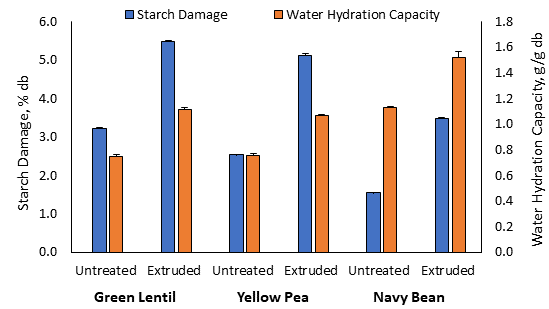
From previous research, it was determined that very high levels of starch damage negatively affect the functionality of pulse flours in bread and spaghetti applications. To limit the amount of damage to the starch in the extruded flours, and maintain a flour consistency after extrusion, a low-shear conveying screw configuration was used. Once treated, the extruded pulse flours were analyzed alongside untreated flours to evaluate their composition and functionality. Boyd and the team noted higher amounts of damaged starch in the extruded pulse flours. Damaged starch absorbs more water which resulted in the extruded flours having an increased water hydration capacity. (See Figure 1) Changes in the starch pasting properties were also seen in the extruded flours further indicating the starch was modified during the extrusion process.
Do Extruded Pulse Flours Affect End-Product Quality?
Differences in the quality of bread (20% inclusion) and spaghetti (30-50% inclusion) made with the untreated and extruded pulse flours were observed, specifically:
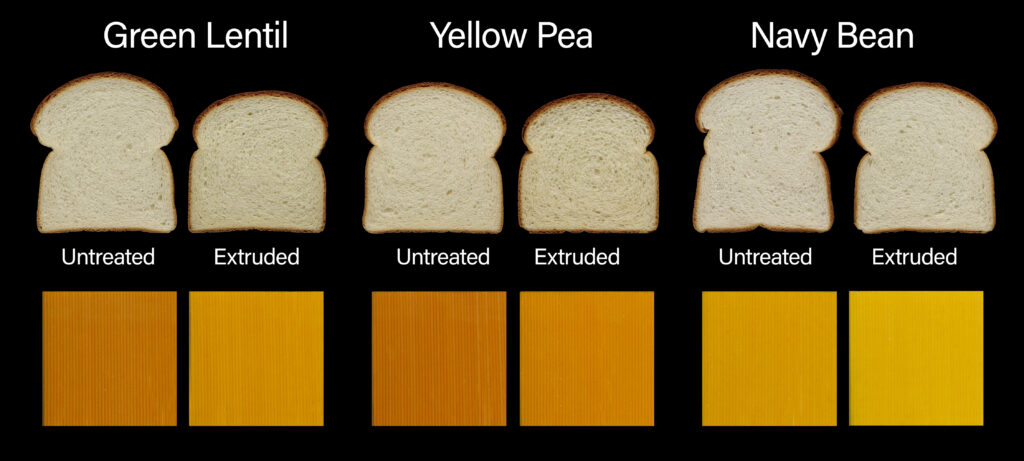
- Breads made with extruded flours had a lower loaf volume and were less bright and creamier in colour.
- Only bread made with extruded navy bean flour had a preferred flavour compared to bread made with the untreated navy bean flour.
- Spaghetti made with extruded flours were brighter and more yellow in colour, with similar cooked firmness to 100% durum semolina spaghetti (control sample).
- Spaghetti made with extruded green lentil and navy bean flours performed well and were preferred based on their texture and flavour over those made with untreated flours.
This activity demonstrated that, overall, the use of extrusion as a post-milling treatment was successful in modifying pulse flour functionality and showed potential to improve the flavour profile of pulse flours using extrusion technology.
As the voice of the Canadian Cereals value chain, Cereals Canada is committed to research and collaborating with partners in agriculture on behalf of the industry.
This is a collaborative research project between Cereals Canada, Agriculture and Agri-Food Canada, Canadian Grain Commission, University of Saskatchewan, and University of Manitoba on the Development of Processing Strategies for Innovative Commercially Ready Pulse Ingredients for the Canadian Food Sector.
Cereals Canada received funding through the Canadian Agricultural Program (CAP) AgriScience Cluster Program.
